

Ads in AI chat apps are arriving faster than anyone can sort them. Thrad’s Roger Dunn brought two visuals to AdGentic: one showing where AI ads can win customers, and one asking whose side an agent is really on?
The showroom test
When I’m in the market for a new car, I know exactly what I’m walking into at the showroom. The salesperson works for Mazda, they’re trying to sell me a Mazda, and I’m open to buying one. It’s all above board.
The trouble starts with a conflict of interest: a salesperson who says they’ll help you pick any brand, while quietly taking a bigger kickback from Mazda. That’s the paid steering I worried about in last week’s essay.
Ads in AI conversations sit all along that range. Some are as upfront as the showroom, like sponsored agents in ChatGPT. Others are less obvious about who’s paying. And as my map of the ecosystem shows, new formats are arriving every few weeks.
So the question worth asking of each one is: who’s doing the talking, and whose side are they on? That’s what my first AdGentic guest has been mapping.
Roger Dunn is chief commercial officer at Thrad, which calls itself advertising infrastructure for conversational AI. In plain English: brands buy ads inside AI apps, and those apps get paid to show them. Thrad says its network reaches over a billion users a month, across hundreds of AI publishers in more than 180 countries.
Before Thrad, Roger spent 20 years in retail media, most recently leading global retail media at Diageo. So he’s one of us. He also writes the AI Commerce Brief, an excellent weekly LinkedIn newsletter that somehow keeps up with the firehose of announcements in this space.
Our conversation has been edited and condensed for clarity.
The conversation
What do brand advertisers get wrong about ads in AI environments right now?
Roger Dunn: The obvious comparison is search. And that’s a fair comparison up to a point: people enter something that signals what they want, and they get content back. But it works a bit differently. A typical keyword search is maybe two or three words. A typical prompt is more like 150 words. So the amount of intent and context the user gives you up front is very different.
So are you funneling demand from your advertiser base into all of those different chat environments?
RD: Yes. For the advertiser, the opportunity is a much more diversified media plan: reaching conversations wherever they’re happening. It’s about the context of the conversation. We target prompts, personas and keywords within that environment, but the real question is where we can find a particular conversation.
We’re also working with the publishers to make sure the ad experience is right. So an ad might not appear on the first turn of a conversation. There might be rules so it comes in later, when it’s relevant, and at the right frequency. Managing that matters, because we want this to be a sustainable channel for both advertisers and publishers.
Show and tell #1: The funnel starts earlier than you think
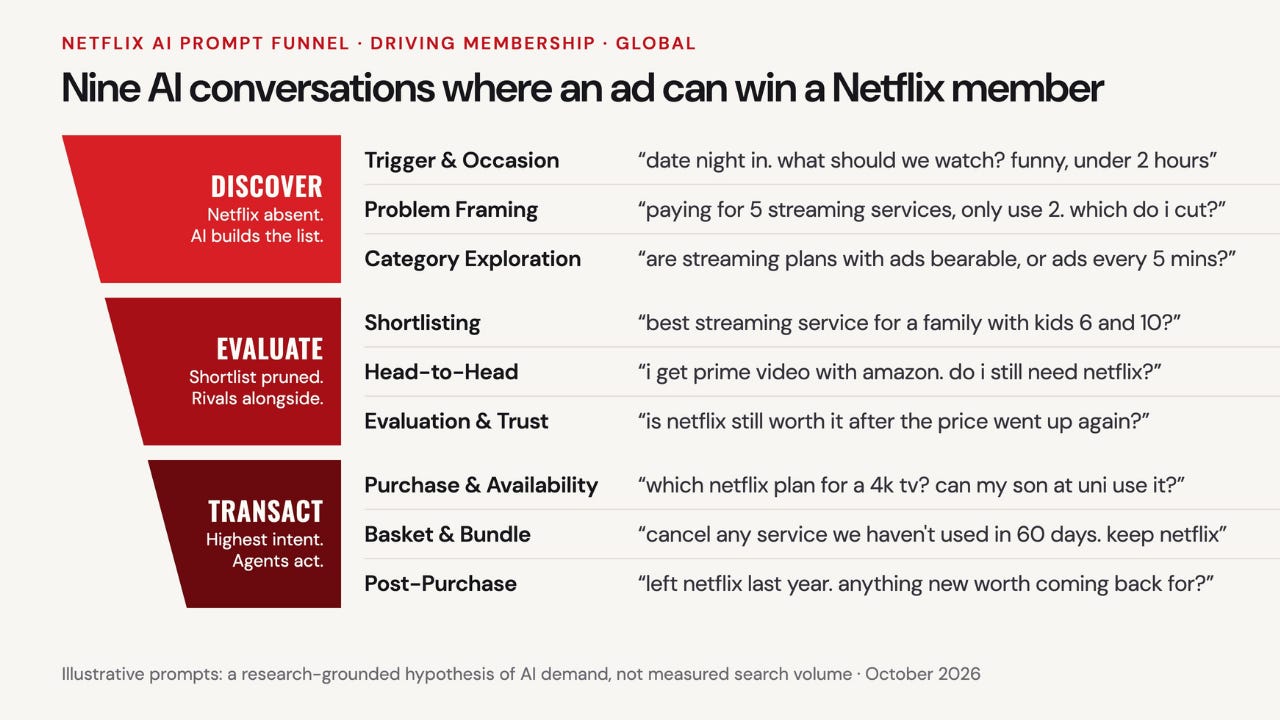
Roger’s first visual takes one example advertiser, Netflix, and maps nine AI conversations where an ad could win a new member.
These prompts are illustrative, not real search data. What I like about this diagram is that it challenges an assumption a lot of advertisers have: that ads in AI belong at the bottom of the funnel, converting someone mid-conversation. Roger’s showing that people turn to AI right at the start of their research too, and that’s a real chance to reach them.
RD: This is just an example. We could easily have used pet food as a CPG example, where people do a lot of discovery around pets and nutrition, then get down into products, then purchases. But it shows the full funnel and the different stages people move through.
With lower-funnel ad opportunities, you’re potentially converting people who were already going to buy anyway. You might move the dial more on incrementally further up the funnel, and we know incrementally matters in retail media and in any advertising. Up there, people haven’t decided yet. They’re in that moment of decision, and that’s the moment to win them. But there are opportunities throughout.
Show and tell #2: Who’s doing the talking?
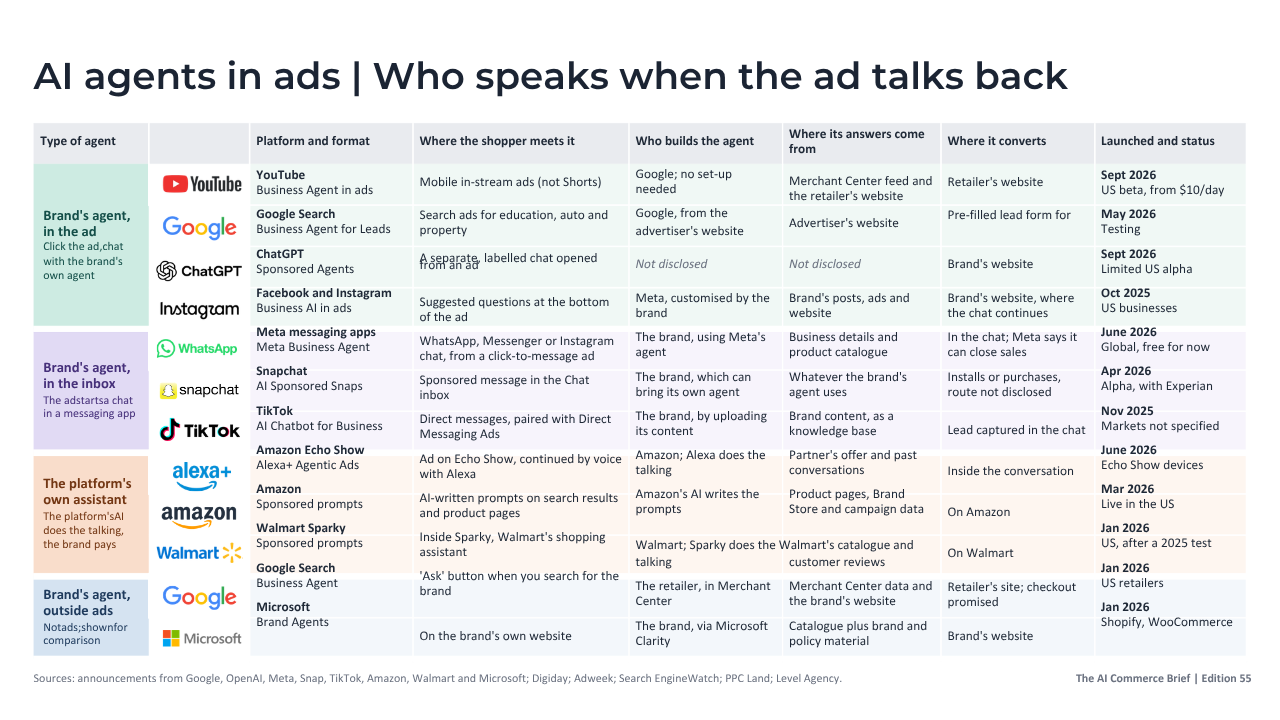
Roger’s second visual breaks down the agent ad formats already out there, sorted by who’s doing the talking. Sometimes you click an ad, on YouTube or ChatGPT, and chat with an agent for the brand. Sometimes the ad opens a chat in your messages, on WhatsApp, Snapchat or TikTok. And sometimes the platform’s own assistant does the talking and the brand pays, like Alexa on Amazon or Sparky at Walmart.
Back to my car showroom: when I walk into Mazda, I know it’s a sales conversation and I’m open to it. How does that comparison stand up for agents?
RD: The interesting thing is to think about whose perspective the agent is coming from. If you’re on Amazon or Walmart, the agent is owned by the platform you’re on, the retailer. It’s going to try to give you all the facts and figures, but it’s there to sell you product as well. I think people are very aware of that, and that’s fine.
Personal agents come from outside, and general-purpose ones like ChatGPT don’t have a particular merchant or even a particular product in mind. In theory, neutrality is more central there. So it depends whose side that agent is working on. The personal agent is on the shopper’s side, supposedly, and the retailer’s agent is on the merchant side.
We haven’t mentioned brands yet, but they come through in the Google and YouTube example. It’s managed by Google, but it’s built on the brand’s own information and content, so the brand’s perspective is brought into the conversation.
A concern a lot of brands have raised with Amazon’s approach is incorrect information. Consumers or even competitors may have said things about a product that aren’t true, and that can end up in the AI’s answer. That’s a huge concern for brand teams. So is change: if they update their packaging or formulation, they need the agents to give current information, not whatever was captured in the past.
RD: That’s very true. In some cases, the information used in these agent experiences was never meant for that. It was a product feed or a Merchant Center update. It was meant to be accurate, but not for this use.
There was an interesting update from Anthropic, which launched some commerce agents for retailers. Its best-practice guidance said the agent should take in all of the brand and product information, which is accurate. But when it reviews and summarizes things like reviews, which are user-generated content, you need stronger guardrails. It shouldn’t take instructions from that content, only from content the brand owns and runs. So there’s nuance in how you set this up and think about it, whether you’re a brand or a retailer.
This [sponsored agents] seems like a new type of sponsored format we haven’t seen anywhere else in digital advertising. Is this the play, or are we at version 1.2 of an endless number of ad types in AI services?
RD: You have to imagine the ads will evolve from here. Even in the last few weeks we’ve had these sponsored agents arrive. ChatGPT just launched a visual ad that shows while you wait for an image to generate. So there’s going to be an evolution.
But I think the opportunity is this: people are typing in natural language, and they may be speaking to these tools more, so conversations get even longer. The intent and context in that is so much greater than someone glancing at a banner or typing two keywords into Google to find some trainers. The ability to target on all that information is the real game changer.
The other angle is what these platforms know about you. A retailer’s agent might be very focused. It knows your shopping history on that site and what you’re browsing right now. The broad LLMs have a much wider view of you, with a history that goes well beyond shopping. They know what else you’re thinking about and asking about. That wider view, and the personal agents that grow out of it, will see the consumer very differently. They’ll be able to help in different ways, and they’ll open up different commercial opportunities than a retailer can.
My takeaways
Roger makes a point about the funnel that should make retail media folks sit up in their chairs. People turn to AI at the very start of their research, before they’ve picked a brand, and that’s where an ad may do the most to change their mind. Sponsored products live at the bottom of the funnel, right at the moment of purchase. If AI conversations become the place where people decide, a lot of that money has a reason to move up the funnel.
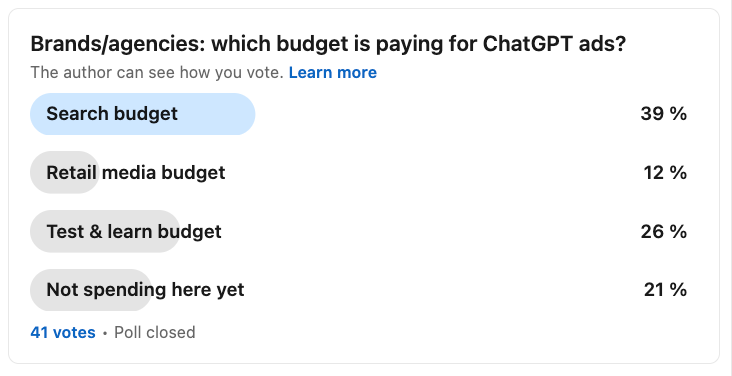
This is admittedly directional information, but a recent poll of my audience on LinkedIn (41 votes) found that ChatGPT ad money is mostly coming out of search budgets (39%). Retail media budgets were the smallest source, at 12%. For now, the funnel shift is a risk on the horizon for retail media, not a hit it’s already taking.
Roger also sorts the agent ad formats already out there by one question: who’s doing the talking? Sometimes it’s the brand’s own agent. Sometimes it’s the platform’s assistant, with the brand paying for the privilege.
I argued in my first AdGentic essay that visible ads beat invisible steering. A brand’s agent inside a clearly labeled ad is about as visible as it gets. A platform’s own assistant speaking on a brand’s behalf is where I’d want to see the label.
Thanks to Roger Dunn of Thrad for joining me. Check out the AI Commerce Brief, his weekly newsletter.
Watch or Listen to AdGentic
This Q&A is based on episode two of AdGentic, a show about advertising in the age of AI, hosted by Kiri Masters. AdGentic is part of the ReFiBuy Media Network.
Watch the full episode below to see Roger’s visuals, or listen wherever you get your podcasts.
Prefer to listen? Find AdGentic on Apple Podcasts, Spotify, or wherever you get your podcasts.