

When social media networks like Facebook, MySpace and Friendster first burst onto the scene, some brands decided they should build a social network of their own. How hard could it be? Debbie Aho Williamson, an analyst at eMarketer at the time, remembers covering the space.
“You’d go to Coke’s website, create a profile, interact with your friends… and a Coke bottle,” she recalled.
Did it work? Clearly not. People’s attention went to the big social networks instead, and eventually so did the ad money.
I see the same urge today. Retailers are rushing to build their own chat assistants, partly to protect the sponsored product ads on their search results pages. I understand why. But if the last 25 years are any guide, the ad money will follow people’s attention, and it tends to pile up in one place.
That’s the pattern Debbie has spent her career tracking. And she says AI is moving through it faster than any ad market before it.
Debra Aho Williamson is the founder of Sonata Insights and author of The AI Ad Economy, a weekly Substack on advertising in AI. She’s a longtime advertising analyst who started covering social media when it was just getting going, and she sees a lot of the same signs again in AI. She also just published a new report with WARC, Sightlines, that looks back over decades of ad spend forecasts to ask whether AI will follow the same pattern as search, social and retail media.
Our conversation has been edited and condensed for clarity.
The conversation
You started out covering social media in its early days. What signs did you see in AI that took you back there?
Debra Aho Williamson: Almost all of my research, and the way I think about new media markets and new places for advertising, comes down to one question: how is consumer behavior changing? That was the big unlock for me when I started covering social. I was paying attention to college students and younger consumers and how they were changing the way they communicated.
A few years ago, as chat platforms like ChatGPT started coming on, I noticed they weren’t just a place to edit an email or write your English paper. They could be really helpful sources of information. Really early on, I remember trying to find wineries in an area I was visiting, and it was eye-opening. This was so much easier than using search. So I started to think that the more people tried it, the more they’d realize this was a fundamentally new way to get information.
That’s where marketing changes. Once consumers gravitated towards social, marketers’ heads just swiveled around: whoa, I’ve got to pay attention to what’s over there. I have the same mentality about AI right now. Consumers are over there. Now marketers need to be there.
KM: That’s the warning I’ve been giving retailers for what feels like a year now. Brands and their marketing budgets are fair-weather friends. The second there’s a new place where consumers are spending time and doing research, that’s where the ad budgets go. Even if the ads are expensive and the targeting is limited early on, they’ll get better, and the budgets will move.
DAW: Exactly. We saw it with social. We saw it earlier than that with search, with digital marketing taking over television. This is a pattern that generally happens quite often in the marketing landscape.
KM: What do marketers misunderstand most about advertising in AI right now?
DAW: I think the biggest misconception is that advertising in AI is just like search advertising.
We have platforms like ChatGPT to sort of blame for that. When ChatGPT launched advertising earlier this year, they made it look a heck of a lot like search advertising, on purpose. That led to the idea that all you need to do is buy some keywords, slap up some text and an image, and voila, you’ve advertised on AI.
OpenAI is no longer promoting that mentality. They’ve shifted away from describing their advertising as anything like search. They’re talking about it as conversational discovery, playing in consideration, that sort of thing.
But for advertisers, it led to this idea that you had to look at your search budget and decide whether to advertise in search or in AI. I think both are important. I don’t think search advertising is going away, even as AI advertising gets bigger. It put a false idea in advertisers’ minds that this was very search-like and could replace search, and I don’t think that’s what it’s going to turn out to be.
(If that sounds familiar, Roger Dunn from Thrad made a similar point in our last episode. Search is the obvious comparison, he said, but it only holds up to a point: a typical search is two or three words, and a typical prompt is closer to 150.)
KM: I hear that too. Agencies and brands keep telling me ChatGPT ads aren’t really performing. My question is: against what? If you’re judging them against a search budget with an action outcome, it’s not a like-for-like comparison.
DAW: Think back to the first ads on Facebook. Back then Facebook was a desktop experience, and the ads were just off to the side, in little boxes, away from everything you were doing in the middle. Everybody complained. These ads don’t work. Who wants to buy them? Everybody’s attention is in the middle.
What did Facebook do with that information? A couple of years later, they invented ads in the newsfeed. They put the ads where people were paying attention, and they made the ad look just like the content around it. The ad looked like a post. It was very novel back then, but it was one of the main reasons advertising in social media took off: the ads became native to the experience.
That’s where we are with AI. An ad that works like a search ad isn’t really part of the experience. It’s kind of off to the side. So no wonder advertisers are saying it’s not working. It’s probably not the format that will eventually make this sort of advertising work.
Show and tell #1: Every ad market ends up with one winner
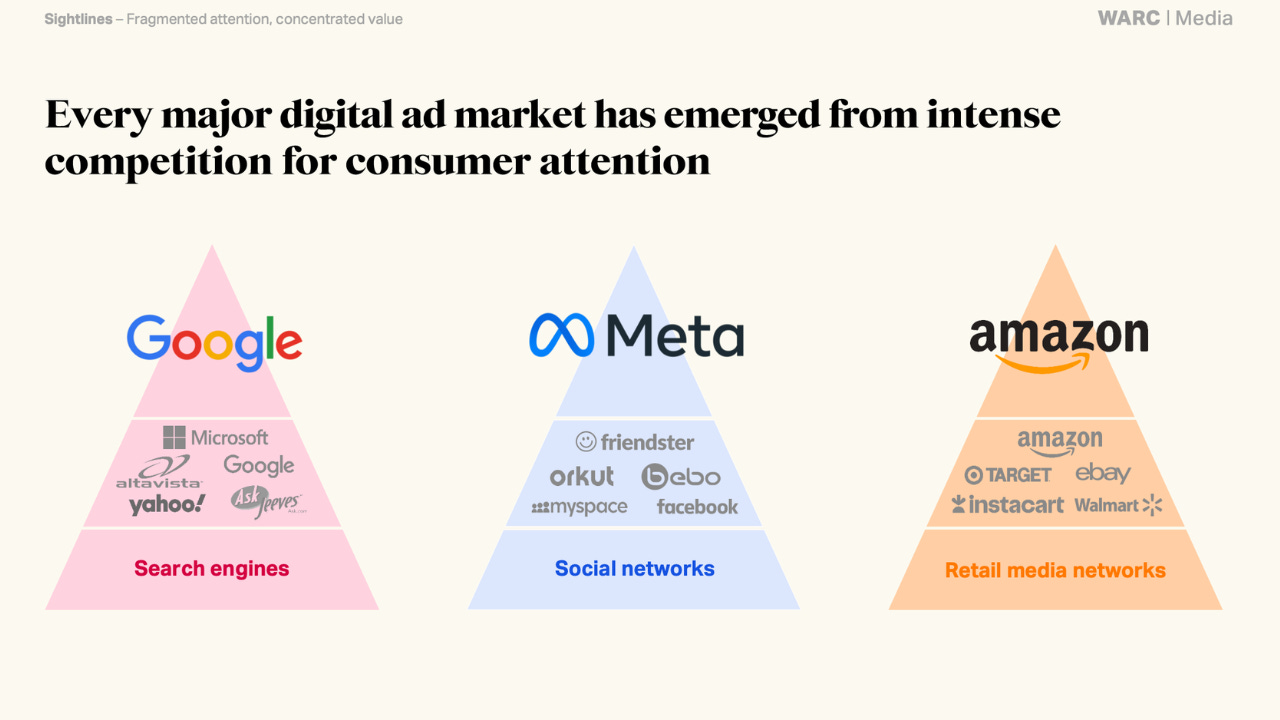
Debbie’s visuals come from her new report with WARC titled Sightlines. WARC has decades of ad spend forecasts, and Debbie spent about six months going through them to see how search, social and retail media each grew into big ad markets. One finding jumped out. As people’s attention spread across more and more places, the ad money did the opposite. In each market, it piled into one company.
DAW: Every major digital ad market over the past 25 years has come out of really intense competition for consumer attention. In the early days of search, there were lots of players before Google became dominant. Same with social, same with retail media networks. And in every transition, one competitor pulled away.
We all talk about how dominant these players are, but when you see it in these pies, it really is incredible. Even as attention fragmented, three companies came away with the lion’s share. Over 90% of search ad spend around the world, outside of China, goes to Google. Meta gets 80% of social. Amazon gets 60% of retail media.
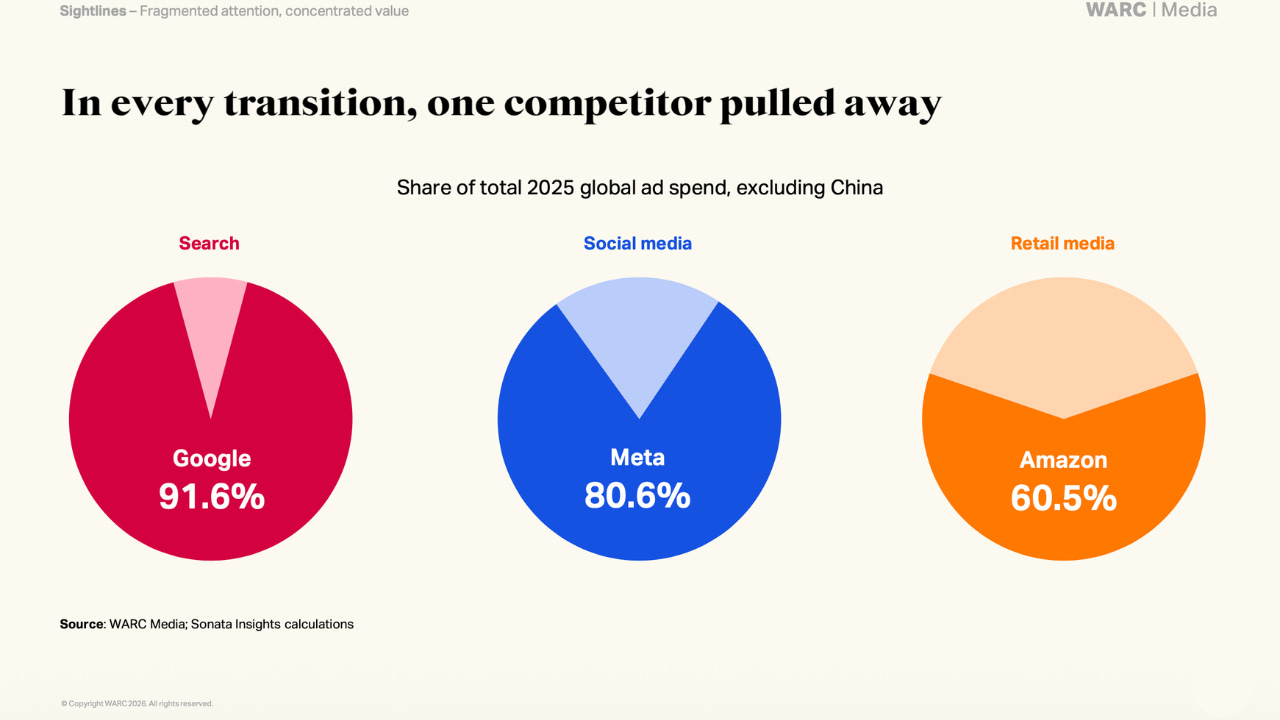
I was actually surprised Amazon was that low. I think there are just so many players still grappling for a piece of retail media budget. We might not have seen the kind of consolidation that has already happened with Google and Meta. That’s just my speculation.
KM: I think there’s a good reason Amazon’s share stays lower, and it’s the nature of retail. A CPG brand that sells on Amazon also sells through CVS and Albertsons, and it needs to fund those channels too. So putting all your ad spend with one retail media network isn’t really an option, the way it might be in search, where only one platform really matters.
Show and tell #2: AI is moving faster than any ad market before it
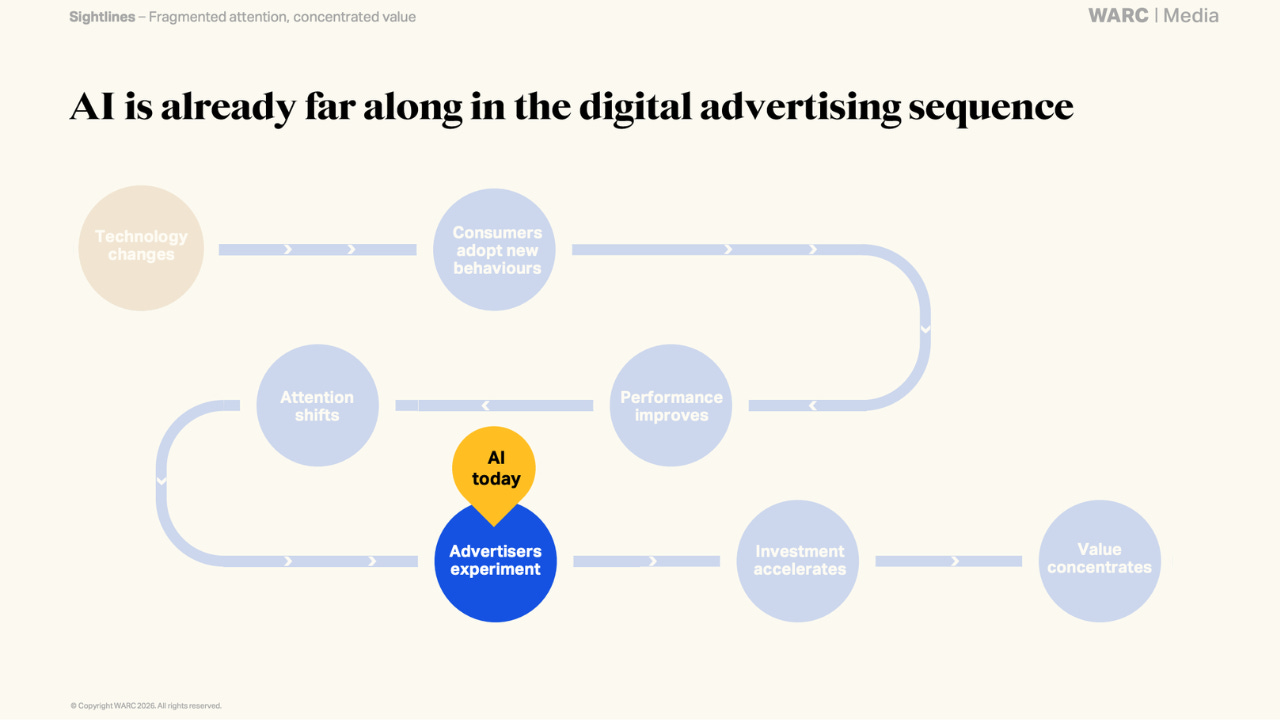
Debbie’s second slide maps the steps every one of those markets went through, and where AI sits today.
DAW: Across search, social and retail media, we found a very predictable sequence of events that makes an ad market grow. Technology changes, consumer behavior changes, performance starts to improve, and more and more consumer attention shifts. Then advertisers wake up and say, okay, now we need to start experimenting. Then investment accelerates, and then value ends up concentrating.
When we looked at where AI was, we were astounded. AI has only been popular since late 2022, so we’re about four years in. And AI media is already at the stage where advertisers are experimenting. Investment hasn’t really accelerated yet, and value hasn’t concentrated. Those are questions for the next few years. But if advertisers think this is moving fast, it actually is moving really, really fast, and that’s different from the historical precedent.
To put that speed in context: Google took about 20 years to pass $100 billion a year in ad revenue. Meta took about 17. OpenAI is aiming to get there by 2030.
That helps level-set expectations. A lot of the complaints I hear from advertisers are about how basic the targeting and reporting are. But this is an infant ad platform that’s still working out what it’s for. And every era before it ended up with ads that looked different, because they used what was special about that experience. An ad on TikTok looks different from an ad on Google, which looks different from an ad on Amazon.
DAW: And each one is native to its environment. I keep coming back to that. Google invented AdWords, and that was the big aha that unlocked ad spending in search. Facebook put ads in the newsfeed, which nobody really understood at first. It looked strange. Now ads in a feed are everywhere.
What’s different now is that all of this is happening in a much more compressed time frame than any previous digital era. That’s what makes it so exciting for me. It also makes it hard for advertisers to keep up, and hard for people to see that what they’re looking at today is an iota of what it could become. That new, exciting thing could arrive at any moment. It could be next month, or three months from now. We’re not going to be waiting ten years for the aha ad format in AI.
Show and tell #3: Three ways this could go
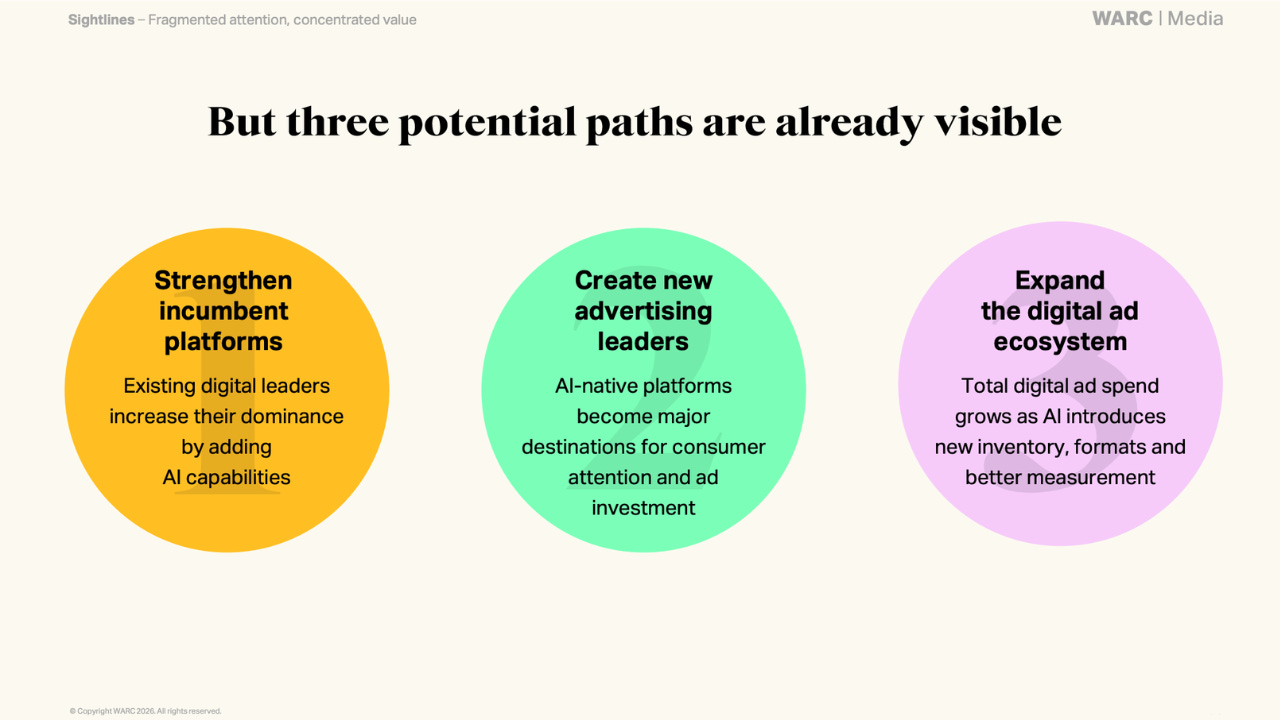
Debbie’s last slide lays out three ways this could go:
The incumbents get even stronger
A new giant, most likely ChatGPT, pulls budget away from them
AI makes everyone’s ads work better, and the whole market grows.
DAW: ChatGPT advertising is the shiny toy of the advertising world right now, and I spend a lot of time thinking about it. But I don’t think we’re in a position to say it’s going to be the next big advertising business. There are incumbents with very large ad businesses to protect, especially Google, Amazon and Meta.
So in this report we chose not to pick a winner. We think it’s better for advertisers to recognize that any of these three scenarios could happen. The incumbents could become more dominant. New leaders like ChatGPT could emerge. Or the digital ad ecosystem could expand as a whole, because AI opens up advertising to new types of budgets and new types of advertisers.
The message to advertisers is: stay flexible. Pay attention to how consumers are using these AI experiences, because I don’t think that genie is going back in the bottle. Make sure you’re present, whether that’s Google with AI Overviews, Amazon with sponsored prompts or ads in Alexa for shopping, ChatGPT, or AI features on retailers and in retail media. There’s so much going on in this space. Experiment with all of it. That’s what will prepare you for the next phase of advertising.
Beyond the big guys
KM: The big AI companies get most of the attention, but retailers, online travel agents and other publishers are building their own chat assistants too. I think a lot of them are doing it because they can see the sponsored product ads on their search results pages are at risk. A retailer’s chatbot will never show up on a market share chart. But it could still matter a lot to that retailer’s ad revenue.
DAW: It’s going to be really interesting. It reminds me of those brand social networks (like Coke). Did that work? No. And I see a little of that in what you’re describing. I don’t think every retailer’s chatbot is going to be successful or generate revenue.
KM: I think they wished it was a thing. They were hoping to keep control, which is what everyone wants today too. They look at ChatGPT aggregating all this content and attention and think, we desperately need a defense against that, so let’s build our own.
DAW: That could happen. Or a retailer could come up with the right mix. A retailer knows its customers far better than any outside chatbot would. If it uses that knowledge of their behavior and purchases to make it easier to get an answer without leaving its site, and gets that message across, then maybe it works. And maybe it could sell advertising against it.
But the broader point, and something I talk about all the time, is that AI media is more than general-interest chatbots. It’s not just going to be ChatGPT or Perplexity, or Claude, if Claude ever has ads. Advertising is going to appear on publishers, on retailers, in apps. It’s going to be a whole ecosystem. And that’s another reason not to assume you know what AI media will look like, or who the winner will be. You really don’t know at this point.
My takeaways
Debbie’s Facebook story will probably resonate with many readers who recall those early days. Today’s ChatGPT ads are the modern equivalent of the boxes on the right-hand side of the page. The format that really unlocks this market probably hasn’t arrived yet. I floated a few candidates in my first AdGentic essay.
For retail media people out there, two things stood out. First, retail media is the least concentrated of the three markets in Debbie’s data, with Amazon at 60%. Brands have to fund a long tail of retailers, and that keeps a lot of networks in the game. Second, the Coke social network is a warning for every retailer building a chatbot. A retailer’s edge is that it knows its shoppers better than ChatGPT does. But knowing your shoppers doesn’t help much if they never think to open your chatbot.
And I agree with Debbie that it’s too early to pick a winner. Test across all of it, and watch where your customers actually go for help.
Thanks to Debra Aho Williamson of Sonata Insights for joining me. Check out The AI Ad Economy, her weekly Substack, and her new WARC report, Sightlines.
Watch or Listen to AdGentic
This Q&A is based on episode three of AdGentic, a show about advertising in the age of AI from the ReFiBuy Media Network, with host Kiri Masters.
Watch the full episode below to see Debbie’s visuals, or listen wherever you get your podcasts.
Prefer to listen? Find AdGentic on Apple Podcasts, Spotify or wherever you get your podcasts: https://adgentic.transistor.fm/.
Stay Ahead of What’s Next in AI Advertising
AdGentic is part of the ReFiBuy Media Network, alongside Retailgentic and RetailPlaybook.